The Exposure Triangle
The Exposure Triangle
There are countless books, videos, and articles that explain exposure in depth, and many of them will go into far more detail than I can here. Think of this chapter as a friendly overview. I’d actually encourage you to read other explanations too — hearing the same idea described in different ways often helps everything click.
So, what is exposure?
Wikipedia gives the formal definition:
“In photography, exposure is the amount of light per unit area reaching a photographic film or electronic image sensor, as determined by shutter speed, lens aperture and scene luminance.”
If that made your eyes glaze over, you’re not alone. Let’s simplify.
Imagine two photos:
One is so bright that the snow becomes a pure white sheet with no texture — that’s overexposed.
Another is so dark that the people in it disappear into the background — that’s underexposed.
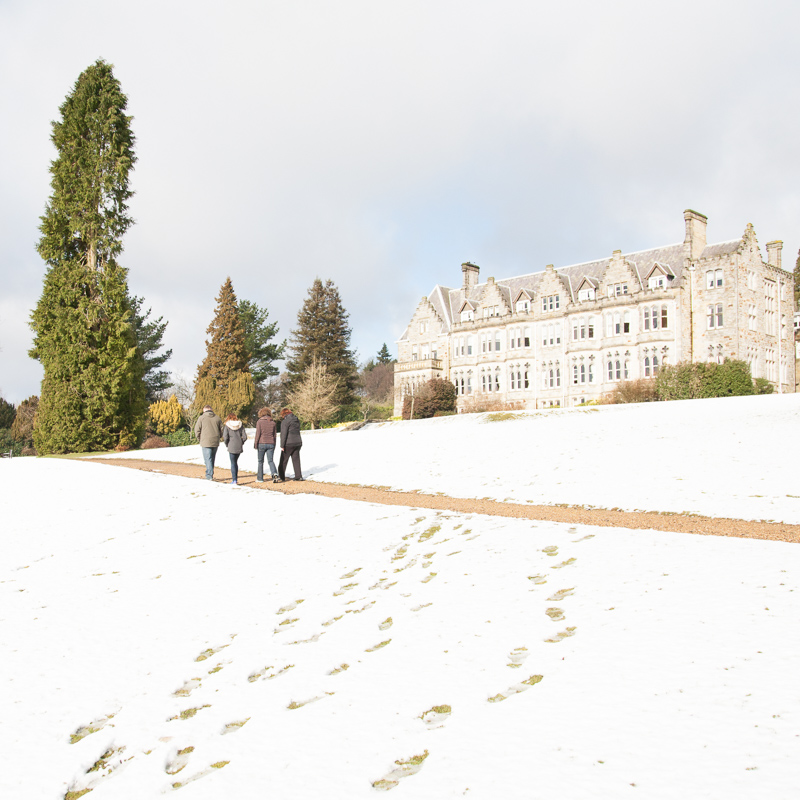
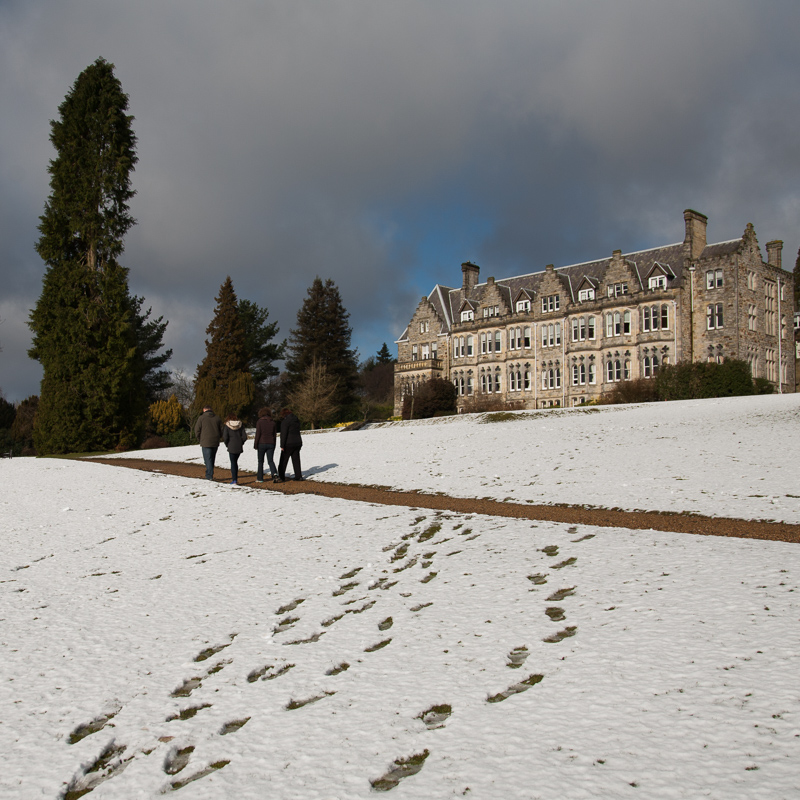
Put simply, exposure is the amount of light your camera captures.
We control this using three settings: ISO, Aperture, and Shutter Speed. Together, these form the Exposure Triangle. Each affects the light in a different way, and each affects the others.
Let’s break them down.
ISO
If you remember film days, this was called ASA. ISO measures how sensitive your camera’s sensor is to light.
A low ISO (like 100) works well in bright daylight.
A high ISO (like 1600) helps in dim indoor spaces.
Think of it as a volume control for light — turning it up or down.
Aperture
Aperture is the size of the opening in the lens.
A wide opening (such as f/2.8) lets in lots of light.
A tiny opening (such as f/22) lets in very little.
Imagine it like curtains: you can open them just a crack or sweep them wide to brighten the room.
Shutter Speed
Shutter speed is how long the camera allows light to hit the sensor.
It’s usually a fraction of a second — for example, 1/200th.
Using the same curtain analogy, it’s how long you pull the curtains apart before closing them again.
Now to the triangle.
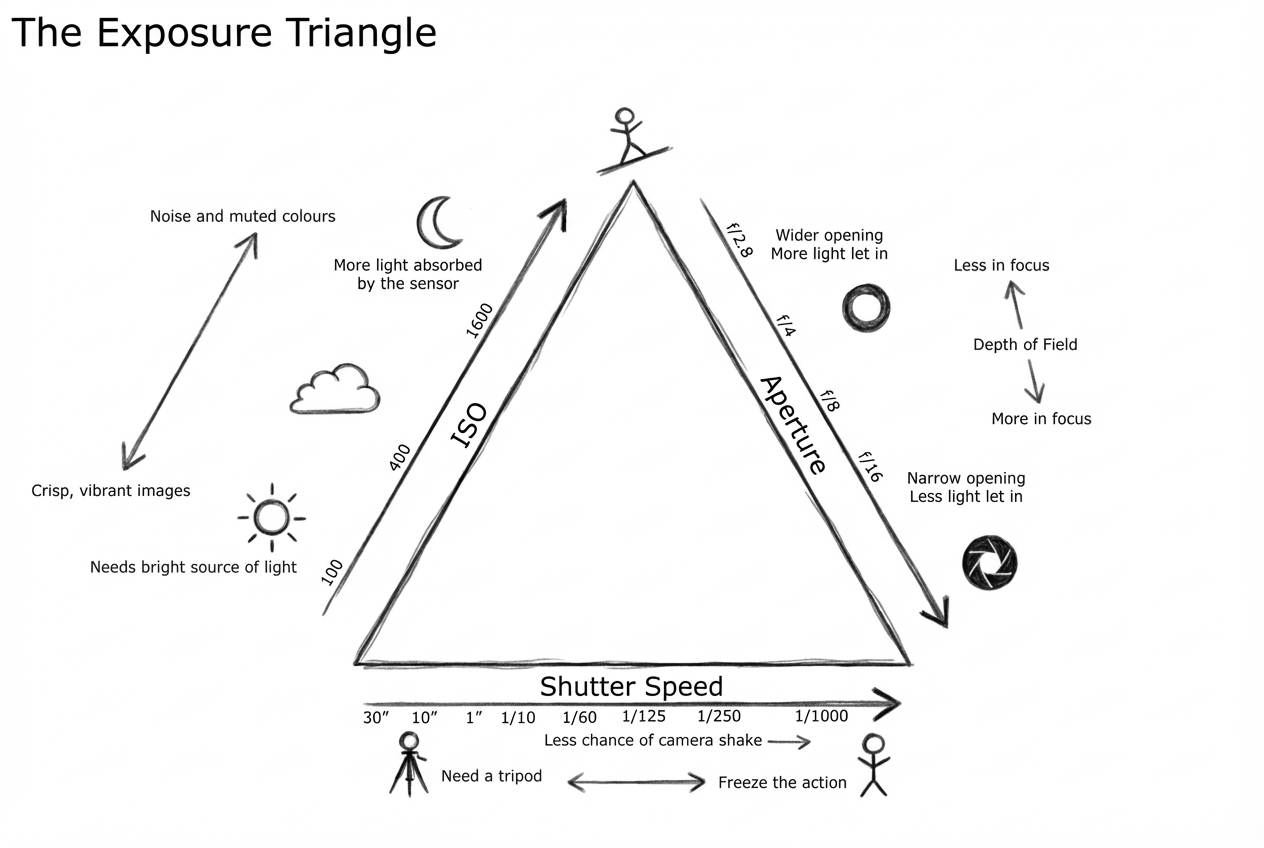
The reason we call these three settings a triangle is that they’re all connected. Change one, and the exposure changes with it.
• Lower your ISO and the image gets darker.
• Widen your aperture and the image gets brighter.
• Use a faster shutter speed and the image gets darker again.
Being able to control exposure means you can make the photo look the way you want it to look. It’s part creativity, part science — your artistic intent working hand in hand with the physics of light.
We’ll explore ISO, aperture, and shutter speed in much more detail in later chapters. For now, just remember the elegant balance between them. In almost any situation, you can arrive at the same overall brightness using many different combinations — but each combination creates a different look and feel.
Which one should you choose?
That decision is the wonderful part: it’s entirely up to you.